
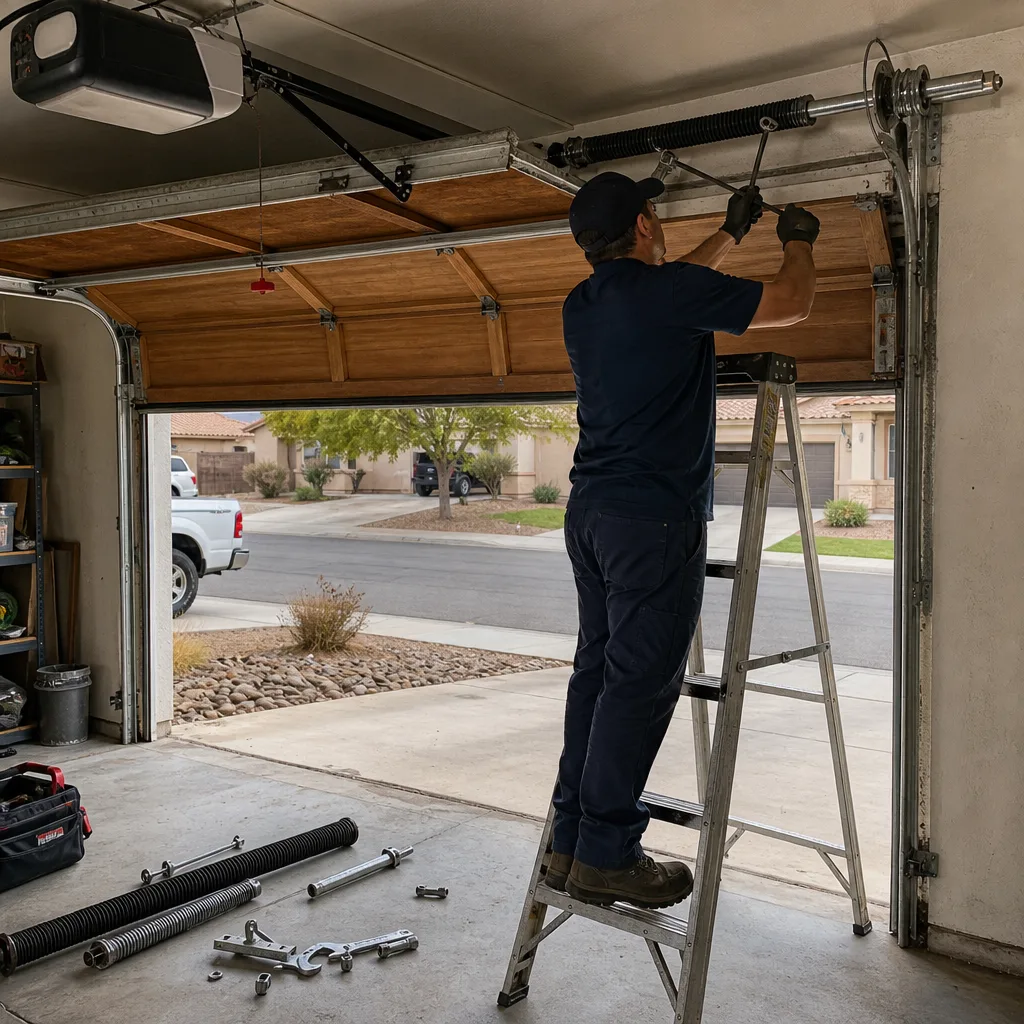
Last updated November 18, 2026
 Raised-panel steel
 Carriage house
 Modern flush
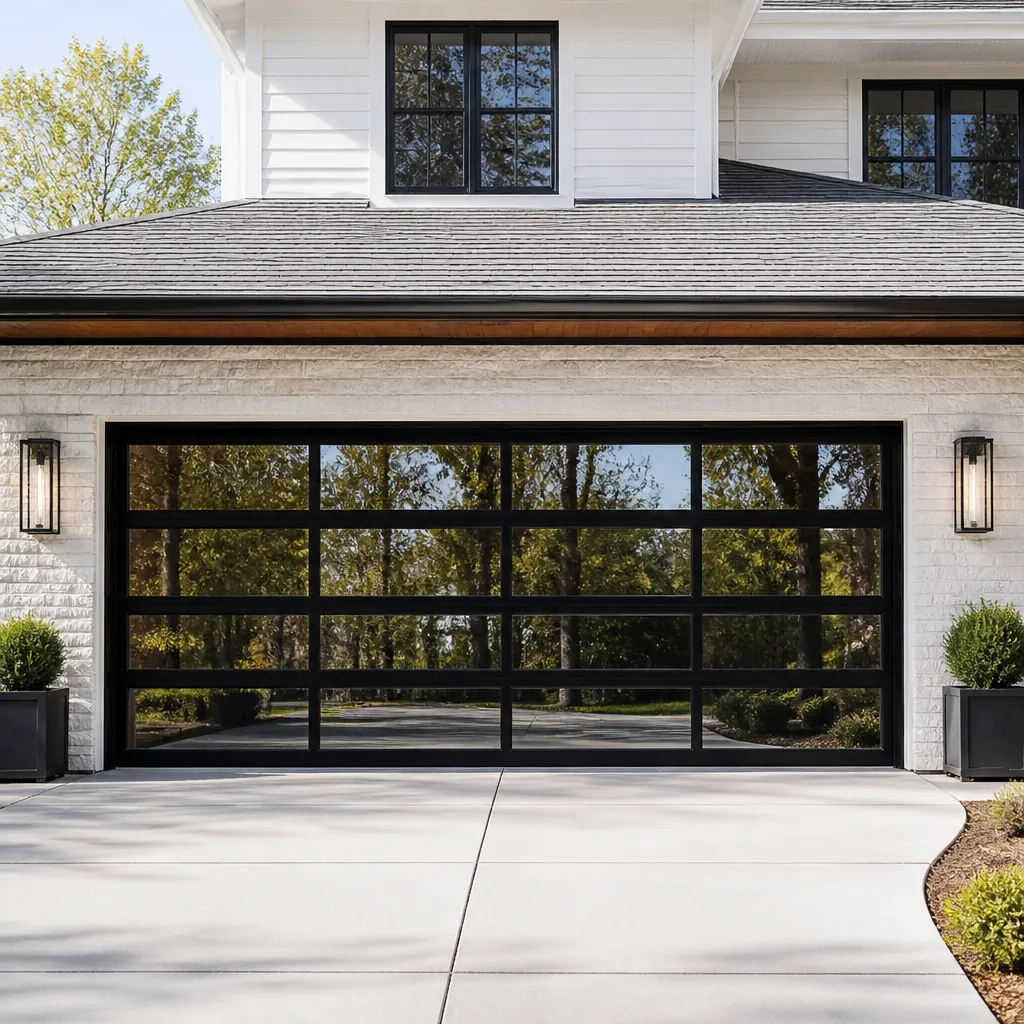 Full-view glass
 LiftMaster openers
 Chamberlain openers
Full 25-point door and opener safety check with every visit - springs, cables, rollers, tracks, and your LiftMaster or Chamberlain opener included
You get a price before we start. It does not change when the pro arrives.
Get your free estimateGarage Door Parts Troubleshooting: Common Problems and How to Fix Them
The most expensive phrase in garage door repair is “while we’re at it.” That little sentence is where a five-dollar problem turns into an eight-hundred-dollar ticket, and it almost always shows up after a misdiagnosis. We’ve re-done plenty of other shops’ work where they swapped a torsion spring when the cable drum had been the problem the whole time. The door behaved the same. The invoice didn’t. This guide maps symptoms to the parts that actually cause them, so you (or the person you hire) chase the right component the first time. We’ll cover the cable-versus-spring misread, lawn-chair-simple roller fixes, the hinge crack people ignore, and exactly what to do in Spring Valley when something fails at nine at night.
Quick Answer
Most garage door problems trace to one root-cause part, and the part is usually not the one the symptom points to: a cable off the drum masquerades as a spring failure, worn rollers masquerade as a bent track, and a cracked hinge masquerades as a “door that’s just getting old.” The fix is to identify the actual failed component before touching anything. Torsion springs and cables are high-tension parts, so anything involving them is a stop-and-call situation, not a homeowner project.
Styles & brands we work with
- Raised-panel steel
- Carriage house
- Modern flush
- Full-view glass
- LiftMaster openers
- Chamberlain openers
Table of Contents
- The Symptom-to-Component Diagnostic Matrix
- Cable or Spring? How to Tell From the Floor
- How Worn Rollers Create Fake Track Problems
- The Cracked Hinge You’re Probably Ignoring
- The Loud Bang: What It Means and What to Do Next
- Catastrophic Failures vs. What Can Wait Until Morning
- Why Spring Valley Doors Age the Way They Do
- What the Parts Actually Cost
The Symptom-to-Component Diagnostic Matrix
Start here. Read your door’s behavior, find it in the list, and you’ll know which component to inspect. This is the table we run in our heads on every call, and it’s the reason we can often quote a price over the phone before we ever see the door.
- Door falls fast on close or slams the last foot: cable off the drum or a failing spring. Both remove the counterbalance that’s supposed to hold the door’s weight. Do not keep cycling it.
- Door binds or shudders going up: a worn roller or a track that’s out of alignment. The roller is the cheaper suspect, so rule it out first.
- Door won’t stay closed (pops back up): bottom seal out of position, or a misaligned latch and strike. Check the seal first – it’s the free check.
- Loud bang on operation, like a gunshot: torsion spring break. Unmistakable. Stop using the door.
- Grinding or scraping noise: roller bearing failure or debris caught in the track. Metal-on-metal means something has lost its bearing.
- Door sags on one side: cable stretched or slipped on one drum, or a broken spring on a two-spring setup.
- Door hangs crooked and the opener strains: binding from a track or roller issue. If the opener is straining, the problem is almost never the opener.
One caution before you climb a ladder: a door is 200 pounds riding on two springs. Every one of these symptoms is safe to look at. None of them invite you to reach for a wrench on the spring assembly.
Cable or Spring? How to Tell From the Floor
This is the misread that costs people the most money, and it happens because a snapped cable and a snapped spring produce an eerily similar door: heavy, crooked, and refusing to move. Here’s how to tell them apart with your feet on the floor.
Cable off the drum: look at the drum – the spool at the top corner above the track. If the cable has jumped the drum, you’ll see it dangling loose, wrapped around the shaft, or frayed at the end. The spring above the door will still look intact. This is often a same-day, relatively low-cost repair because the counterbalance spring itself is fine and only the cable and its fasteners are swapped.
Spring broken: look at the torsion spring across the top of the door. A broken spring shows a clear gap – a spring that was one piece is now two, and the halves have separated. If your springs are the extension type running along the sides, a break shows as a stretched, gaping coil. That’s a different repair entirely, because a broken spring means the door’s weight is no longer balanced, and balancing it must happen before anything else is touched. We won’t quote a cable job as a spring job or the reverse, and if a shop quotes you one without confirming the other, ask them to show you the part on the door.
If you’re not sure from the floor, don’t guess and don’t cycle the door to “test” it. Call and describe what you see. In our experience, a door that gets cycled three or four more times after a cable comes off tends to do secondary damage to the drum or the bottom bracket.
How Worn Rollers Create Fake Track Problems
A noisy, binding door that looks like it needs a track realignment usually needs rollers. Here’s the wear pattern to look for: stand under the door (open, held by the opener, door off) and look at each roller. A healthy nylon or steel roller rolls smoothly on its bearings. A worn one is flat-spotted, has a sheared bearing, or is dragging a dry, rusty stem instead of rolling.
When the roller is worn, the door doesn’t ride true in the track. It binds on one side, shudders on the way up, and the whole assembly leans against the rails. A shop that doesn’t check rollers first will “fix” this with a track adjustment that gets the door quiet for a week and then the bind comes back. The track was never the problem. The rollers were.
Ten rollers at a few dollars each routinely fixes what looks like a much bigger repair. We’ve seen doors quoted for full track realignment that were cured by swapping the rollers and greasing the hinge points. Ask what’s inside the quote – if it’s track work and nobody’s looked at the rollers, get a second opinion. On the opener side, a Genie or Chamberlain unit straining to lift a binding door will burn out its gear and capacitor eventually; fixing the binding is what protects the opener.
The Cracked Hinge You’re Probably Ignoring
Look at the hinges on the top sections and the corners of the door. A cracked hinge – a hairline split across the metal where the roller stem inserts – is the part homeowners walk past for months. It’s cheap and visible. It’s also a structural signal: that hinge holds the section edges together, and when it fails, the door’s own weight starts working to pull the panel joints apart.
A door with a cracked top-corner hinge doesn’t collapse on the driveway the next day. It gets worse over months, and the eventual failure is a door that comes down crooked and won’t sit square in the opening – a much bigger repair because now you’re into panels, not a hinge. Replace the cracked hinge early and you stop that chain. If a section is already separated at the seam, that’s a door-off situation and a call, not a hardware upgrade.
We check hinges on every service visit, including ours in Spring Valley, because they’re the cheapest failure in the whole system to catch. If you’re up on a ladder looking at one, the door should be closed and the opener disconnected – and don’t put a hand between the sections.
The Loud Bang: What It Means and What to Do Next
You’ll hear it from the other end of the house. A torsion spring lets go with a rifle-crack bang, and then the door is dead weight sitting in its tracks. Here’s the sequence, in order:
- Stop using the door immediately. Don’t press the button to “see if it works.” A door with no counterbalance is 200 pounds of load on an unpowered drum and the opener’s gear teeth – it can drop, twist off a track, or strip the opener.
- If the door is open and blocking a vehicle, don’t force it down. Leave it up and call. A trained technician secures it safely; a homeowner sliding a bent door down by hand has injured themselves doing exactly that.
- If the door is already closed, barricade it from the inside with a chair or a trash can so nobody (especially a kid or a guest) opens it out of habit. That little sign on a door goes a long way.
- Take a picture of the spring from the floor, and call. We can usually quote a same-day replacement from the photo and hold that number when we arrive – the 90-Day Done Right Promise covers the repair in writing.
A torsion spring breaking on a Spring Valley afternoon in July, with the door sitting in full sun, is more common than people expect. The system is designed to hold a specific cycle count, not forever.
Catastrophic Failures vs. What Can Wait Until Morning
Not every garage door problem needs a 2 a.m. call. The trick is telling the ones that do from the ones that don’t, so you’re not paying for an emergency call on a problem that’s actually fine until Tuesday.
Call now (emergency):
- Broken torsion spring with the door stuck open or down.
- Cable off the drum with the door in the up position – it can fall.
- A roller out of the track with the door hanging crooked and the opener still trying to pull it.
- Any door that has come partially off its tracks – the whole load is unsupported.
Can wait until business hours:
- A squeaky or noisy door that still moves normally.
- A door that closes crooked but still closes fully – note it and call in the morning.
- A cracked hinge on a door that’s otherwise operating smoothly – get it quoted, get it fixed.
- A door with a dead opener remote (check the battery first).
Until the technician arrives for a cable-off-drum or an open door with no counterbalance, keep the door closed if you can, block the control button if you can’t, and don’t try to lift it by hand. We answer the phone in Spring Valley around the clock, and we’ll tell you on that call whether you’re looking at a tonight or a tomorrow. Call (888) 318-1978.
Why Spring Valley Doors Age the Way They Do
A door here lives a harder life than one on the coast. Spring Valley’s high-desert swings – afternoon highs into the triple digits in summer, freezing nights in winter – cycle the metal and grease the way a hundred-thousand-mile commute wears the tires. Torsion springs here commonly land closer to the lower end of their rated cycle count, and we tell homeowners to think of them the way you think of tire miles: I’ll tell you how much is left on yours, but I can’t tell you from the driveway that they’re gone until they’re gone.
The dry heat also dries out the grease in the hinge points and roller bearings. A door that ran quiet for years starts to squeal because the lubricant baked off, not because the parts died. A quick check with a light film of garage-door grease on the hinges and the roller stems does real good work out here. The sun’s the other factor: doors on south-facing walls get more thermal cycling than shaded ones, and you’ll see the wear show up there first. It’s a reason we ask which direction the driveway faces before we quote a full set of rollers.
What the Parts Actually Cost
Numbers people haven’t had quoted in years are often the ones that surprise them. Here’s the honest range for parts and the labor to fit them, so you can see whether a quote is in the neighborhood or whether “while we’re at it” has walked in the door. Every one of these is quoted and agreed before we touch the door, and that number holds when the truck shows up.
- Single torsion spring replacement: $180 – $340 installed, higher for two-spring setups.
- Cable replacement (off the drum): $120 – $220 installed, includes the cable and the low-cost parts that come with it.
- Full set of 10 rollers: $90 – $180 installed, and the most common “big” repair that turns out to be cheap.
- Hinge (per hinge): usually a few dollars in hardware, plus modest labor to swap and re-align.
- Bottom seal replacement: $90 – $220 depending on door width.
- Track realignment: $150 – $300, quoted only after rollers have been ruled out.
If your quote is far outside these ranges, ask what specifically is being replaced and get a written second opinion. Our free second opinion on any written estimate is how a lot of Spring Valley neighbors find us – bring us the other shop’s paper, and we’ll tell you honestly what we’d do and what we’d leave alone.
Common Mistakes to Avoid
- Replacing the spring without checking the cable drum. A failed drum can make a new spring fail within weeks. We’ve seen it in the field more than once – the spring gets swapped and the drum is the actual culprit. Look (or have someone look) at both before ordering parts.
- Chasing a track problem without inspecting rollers first. Worn rollers create the same bind and noise as a bent track. Replacing 10 rollers at a few dollars each routinely solves what looks like a $200 track job.
- Cranking the opener up to compensate for a binding door. If the opener is straining, the problem is almost never the opener. Forcing it just wears out the gear and capacitor on that LiftMaster or Chamberlain.
- Painting over a cracked hinge. It’s a structural part, not trim. Paint hides the crack that tells you a panel is starting to come apart.
- Running the door on a broken spring “just to close it tonight.” The door has no counterbalance. The opener’s gears will take the load, the door can twist, and the repair gets bigger.
- Taking a phone quote that changes at the door. Ask for the number in writing. We quote on the call and hold it at the driveway, and the 90-Day Done Right Promise is right there on the invoice.
- Assuming a slow door means a failing motor. A door that lifts slow or unevenly is usually fighting its own weight – a binding roller, a stretching cable, or a spring that’s tired. The opener is the last thing to blame.
See the difference
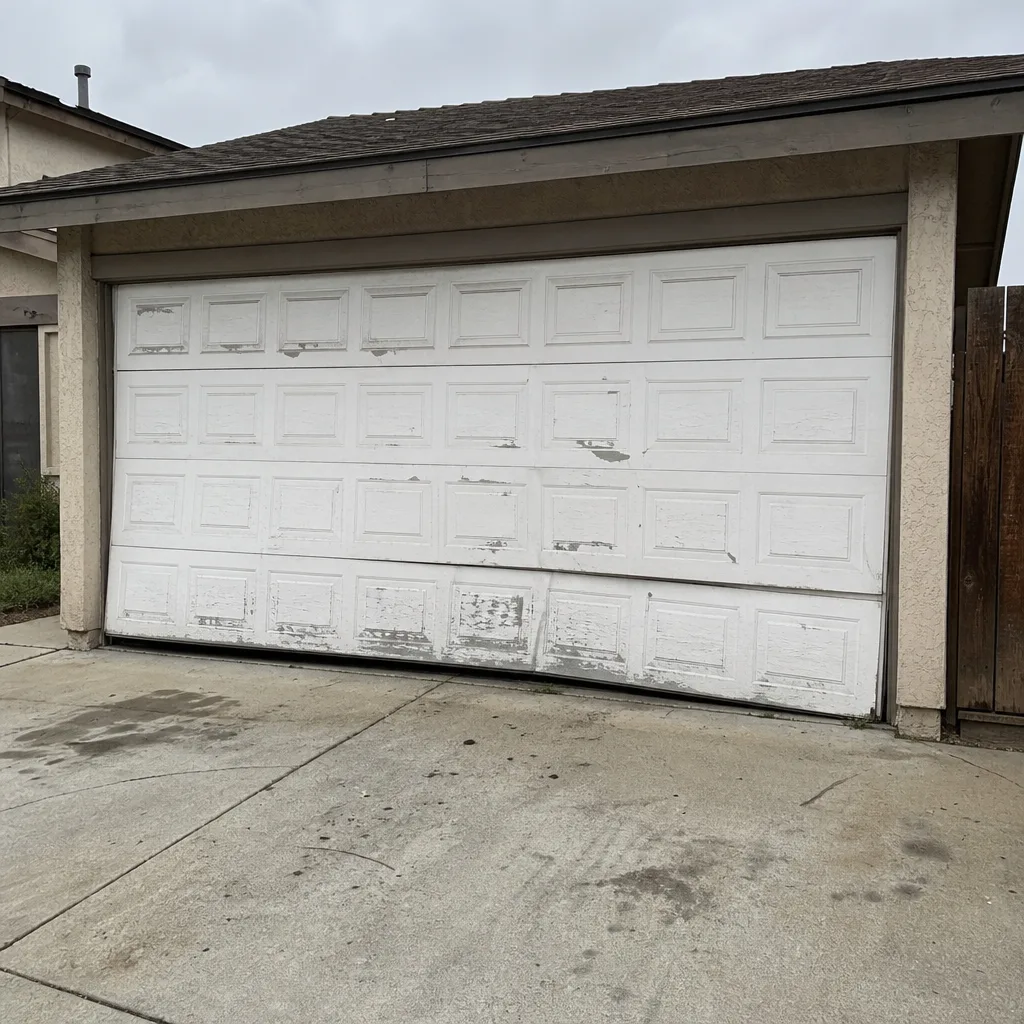 Before
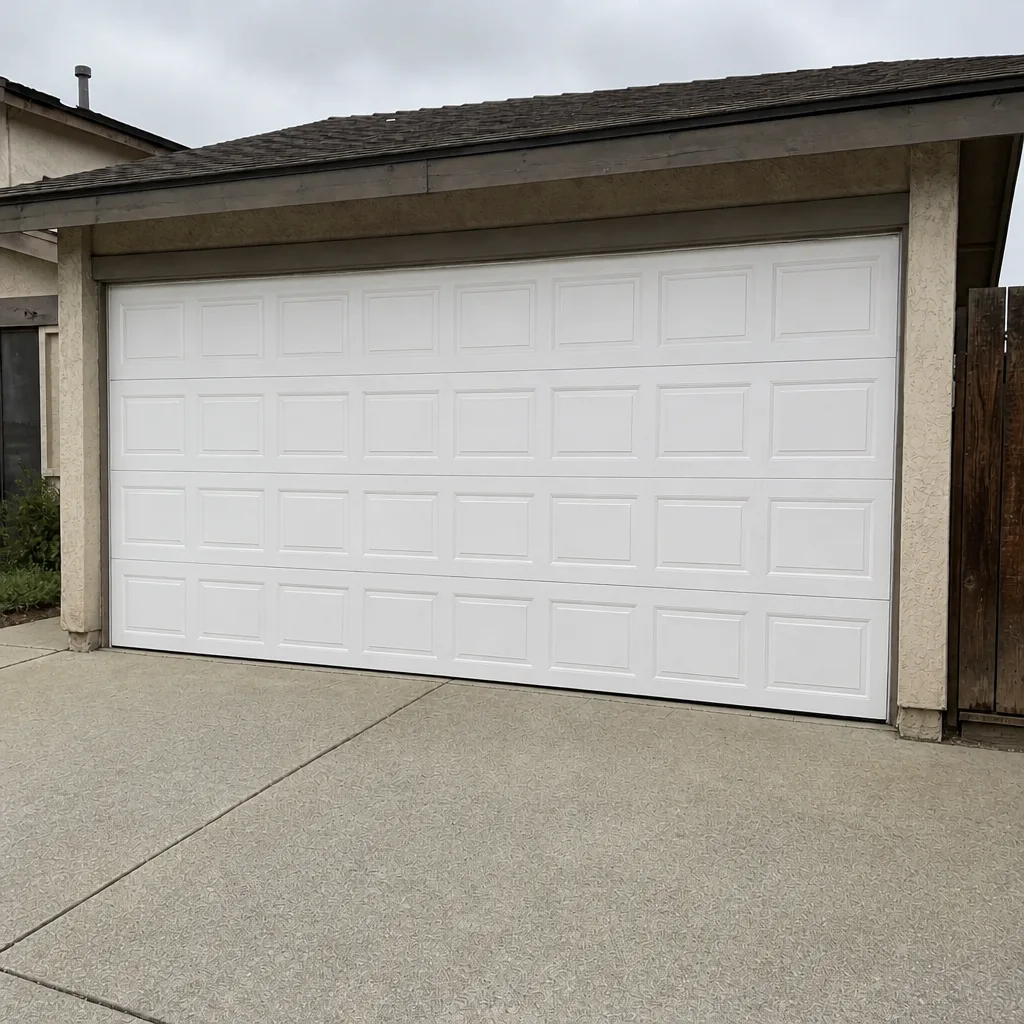 After
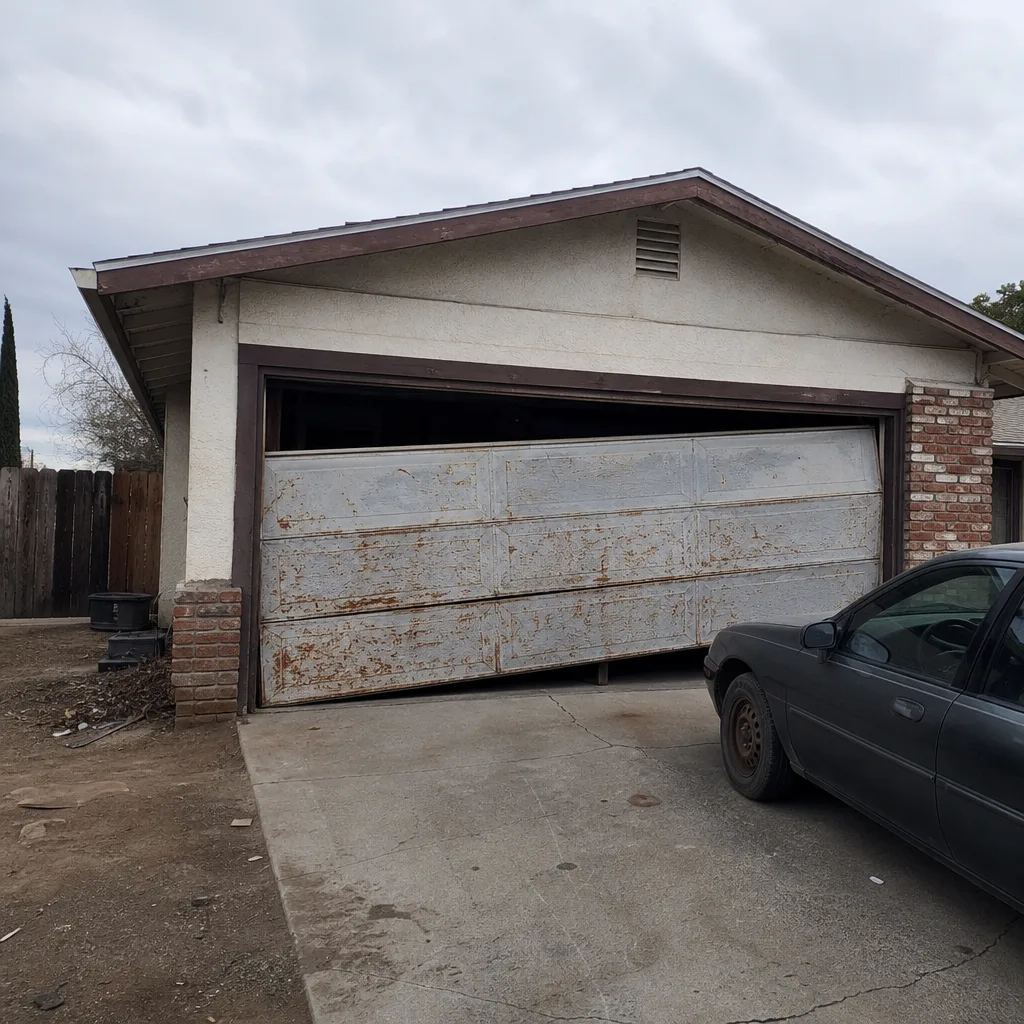 Before
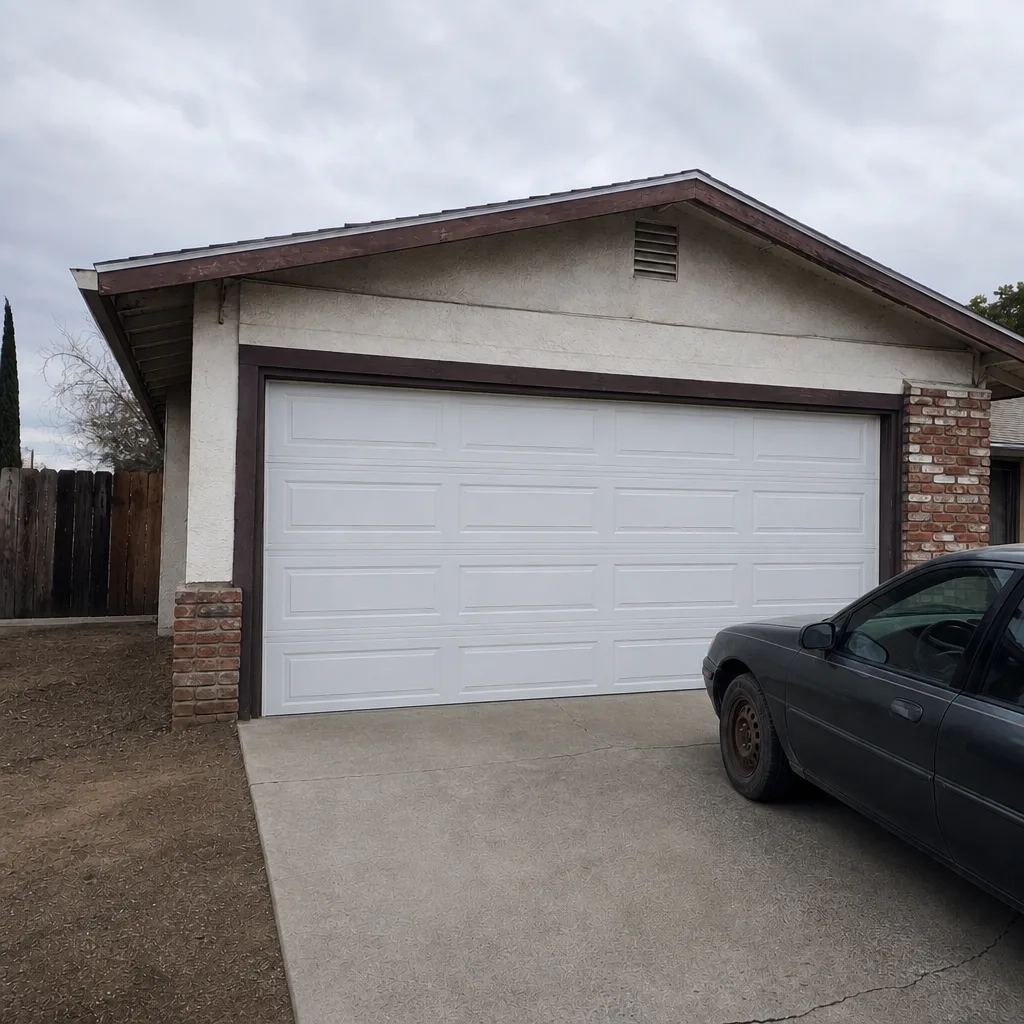 After
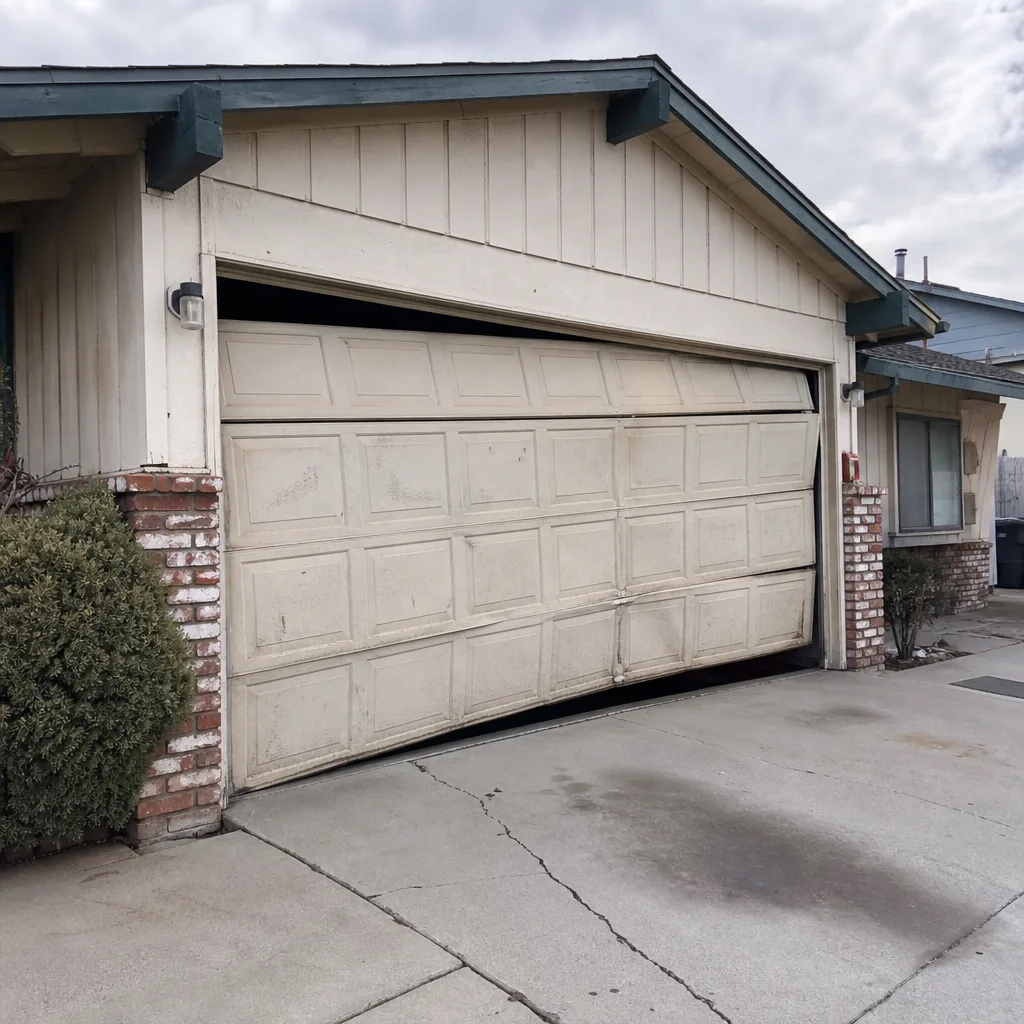 Before
 After
When to Call a Professional
Call us when the door has lost its balance point: any broken spring, any cable off the drum, any door hanging crooked or off its tracks. Call when the door has started to fall rather than lower. Call when a hinge at the top corner is cracked and you want it looked at before it becomes a panel problem. And call when you’re not sure – our phone is answered by a live person around the clock, and a two-minute description over the phone usually tells us whether you’re looking at a same-day repair or a scheduled visit. Otto’s Garage Door Spring Valley offers free estimates in Spring Valley, we charge no trip fee inside the home county, and our technicians have up to 22 years of experience across every major brand. Call (888) 318-1978.
Frequently Asked Questions
A single torsion spring replacement in Spring Valley typically runs $180 – $340 installed, and two-spring setups sit higher. The price is quoted and agreed before any work starts and never moves at the door. Call (888) 318-1978 for an exact quote – estimates are free.
Look at the spring across the top of the door for a visible gap between the halves – that’s a break. Look at the drum above the track for a cable dangling or wrapped around the shaft – that’s a cable off the drum. The spring above the door will still look intact in a cable-off case, which is why the door behaves similarly. If you’re unsure, call before cycling the door again.
In most cases, yes. Spring and cable repairs are the bulk of our same-day work in Spring Valley, and we answer around the clock. Call and describe what the door’s doing; if it’s a same-day job, we’ll tell you on that call. Call (888) 318-1978.
Because the track usually isn’t the problem – the rollers are. Worn, flat-spotted, or dry rollers make the door ride crooked, and the bind shows up on the track side. Have the rollers inspected before paying for a track realignment.
Yes. Our technicians are licensed and insured, background-checked, and trained across all major brands including LiftMaster, Chamberlain, Genie, Clopay, Amarr, Wayne Dalton, Craftsman, and Raynor. Every job is backed by our 90-Day Done Right Promise in writing.
Stop using the door and don’t press the button to test it. If it’s already closed, block it from the inside so nobody opens it by habit. If it’s open over a vehicle, leave it up and call – don’t force it down. Call (888) 318-1978 and we’ll walk you through the next step.
The Bottom Line
Troubleshooting a garage door is really a matter of following the symptom back to the part that caused it, then fixing that part and not the one next to it. A cable off the drum is not a spring. A worn roller is not a bent track. A cracked hinge is not a door that’s just getting old. The money you save by diagnosing correctly – and the “while we’re at it” charge you don’t pay – is the entire point of this guide. If you’re in Spring Valley and you’d rather have a straight answer than a sales pitch, call us at (888) 318-1978.
Ready to stop guessing? Otto’s Garage Door Spring Valley answers the phone around the clock, quotes the job on the call, and holds that number when the truck arrives. Call (888) 318-1978 for a free estimate, ask for our free second opinion on any written quote you’ve got, and take $40 off any repair over $200. We’re the locally owned, owner-operated shop where the name on the van is the name on the license – and where a spring is a spring and a roller is a roller. Our technicians have up to 22 years of experience, and our 90-Day Done Right Promise is in writing on every job. For the full picture of what we do across garage door repair in Spring Valley, our garage door installation in Spring Valley, and garage door opener repair & installation in Spring Valley, start at Otto’s Garage Door Spring Valley home or just call.
Written by the team at Otto’s Garage Door Spring Valley.